


There wasn't a single defining moment that led me to furniture. It was a gradual evolution. I've always had a keen aesthetic sensibility, deeply drawn to beauty with an innate drive to create. For a long time, that sensitivity showed up in interiors—in the way a room could be built from a combination of furniture and objects until it felt balanced and greater than any single piece within it. My background is in creative direction, where I spent years building narratives in hospitality alongside remarkable talents in the design world and beyond. That instinct—combining a profound attention to detail with the ability to build a cohesive story out of disparate elements—is the foundation of everything I do now. Over the last few years, however, my attention shifted from the room to the object itself. I became fascinated by the process behind the work: the raw materials, the precision, and the discipline that craftsmanship demands. Ultimately, I came to see that level of craftsmanship as its own quiet, powerful art form.
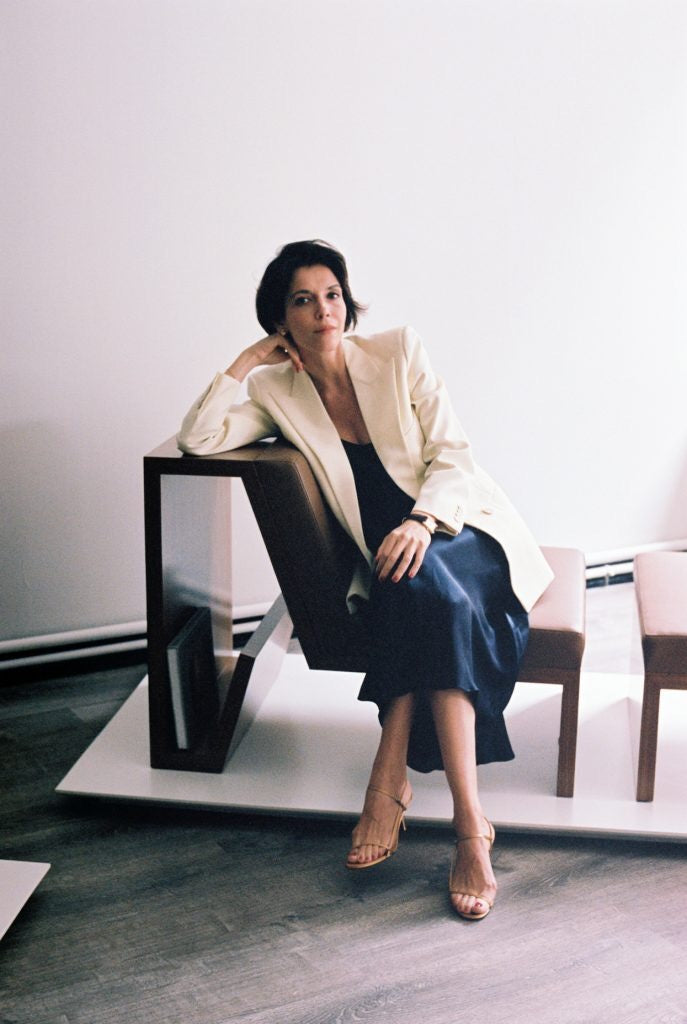
Atelier FM: Quiet Confidence
What first drew you to the world of art and design? Was there a defining moment or experience that set you on this path?
Can you tell us about your creative process? How do ideas come to life for you, from the first spark to the finished piece?
My creative process naturally starts with a narrative. Long before I draft a form, I begin with a feeling or a ritual rather than a shape; I can't create a table just to create a table. There needs to be an intention behind it—a story, a purpose—so it exists as part of something bigger than itself. Because the narrative always comes first, my collections are usually intimate by design, rarely exceeding eight or nine pieces, and each one must speak to the others before anything else can fall into place. From there, the idea finds its way into material. I choose these mediums with great precision, allowing the material to speak before form or proportion. To me, the material must be respected before it is shaped; it is the heart of the piece. Once that is settled, I select the right craftsmen for the collection. I'm incredibly fortunate to work with some of the most talented artisans in the world. Coming from diverse backgrounds and disciplines, each brings a unique strength that I try to showcase rather than smooth over. Together, we find the exact restraint each piece needs. As a self-trained designer, my process has never been about inherited technique. Instead, it is built on instinct, tested repeatedly against master craftsmanship. My dream, after all, has always been to be an architect. I think that longing has never really left my work—it just changed scale. When I design a piece, I am thinking about structure before ornament, about how a line holds weight, about proportion and the rigor of geometry. My pieces tend toward rectilinear forms, clean edges, and a kind of quiet discipline in how the lines meet; that is the language I use to build an object. In a way, every piece I make is a small building. It must stand on its own logic, hold its own structure, and justify every line before it earns the right to also be beautiful.

Materials often tell their own stories. How do you choose your materials, and what kind of dialogue do they create within your work?
Materials do tell their own stories. I choose them for what they truly are, not what they can be dressed up to look like. At Atelier FM, material is never a surface to decorate over—it is the starting point of the design itself. I gravitate toward natural materials because they carry history, character, and an innate elegance beyond their physical beauty. For our first two collections, exotic wood veneer was our anchor, though I am always eager to explore new mediums. I look for veneers with distinct grain patterns and natural imperfections that catch the light differently throughout the day. Rather than hiding these traits, I leave the veneer honest so the final piece feels both timeless and modern. From there, I select a companion material to create a balanced dialogue. Sometimes it is stone or leather, which grounds the piece with an architectural, quiet presence. Other times it is parchment or wool, adding a softer, more tactile texture. Lately, I have been drawn to plaster, ceramics, and bronze for new concepts, bringing a deeper sense of weight and permanence to the forms. Ultimately, these pairings are never decorative choices layered onto a finished idea. They are the idea. By keeping each material close to its original truth, the final piece highlights the raw beauty of the medium and the skill of the craftsman, rather than just the hand of the designer.
How has your style or approach evolved over the years? Were there pivotal moments that shaped your evolution as an artist/designer?
The defining moment for me was seeing a table from the Italian designer Gabriella Crespi's Plurimi series for the first time. It was so mesmerizing that it sealed my direction, and I knew instantly I had to design furniture. What captivated me wasn't just how it looked, but how it transformed: a single piece holding multiple lives, shifting form to meet the needs of the moment. The idea that furniture didn't have to be static changed everything. It was mysterious, functional, and stunning. Initially, I became focused on using metals to create striking, sculpture-like furniture that was highly elegant yet undeniably loud. I developed several prototypes that I loved, but I couldn't find the right artisans who were up to the challenge and could execute the metalwork to the level of precision I required. Eventually, I set the designs aside. Over time, living with those metal prototypes in my own home, my taste shifted. The very elements that had first drawn me in—the high shine and the loud presence of the metal—began to tire me. My style was naturally evolving, becoming quieter and more subdued. Because I still believed deeply in the underlying forms, I decided to recreate them in a completely different medium: wood veneers. This transition led me to a new group of master craftsmen, and I fell in love with the art of hand-applied veneer. It is truly like painting with wood. The book-matching and the soft, organic lines brought a complete transformation to the designs; it felt as if they were always meant to exist this way. Looking back, it wasn't just the material that evolved; it was my perspective on design. I no longer wanted furniture that announced itself. I wanted it to hold your focus quietly, like a well-kept secret, letting the medium and the craftsmanship speak instead of me. That, to me, is quiet confidence: not needing the room to turn and stare, but knowing the piece holds its own in silence.


Your work often balances personal expression and external expectations. How do you navigate that?
I navigate that line by remembering that my first loyalty must always be to the narrative and the material. In an era where social media has made fast design and instant novelty the norm, I find it impossible to create an object simply because the market asks for it; there must first be a deeper reason for it to occupy space in the world. A piece requires a personal story and an emotional grounding before I can begin drafting. That said, I do not see the external expectation of usefulness as a compromise to my artistic expression. A writing table must still hold a dialogue with the person using it; a coffee table must earn its place through utility. Meeting those functional needs is a beautiful, grounding challenge for me. I protect my creative freedom by maintaining strict boundaries and a deliberate pace. This is why, since our launch, Atelier FM has presented only two collections. Within this patient rhythm, we have built a very specific aesthetic and a dedicated following. Our work explores the quiet strength of simple, restrained forms that speak to discretion, grounded always in uncompromising quality. Ultimately, bypassing the noise allows us to advocate for a gentler pace, creating deeply personal pieces that start a dialogue and are made to accompany a lifetime.
— Fabiana Machado
What role does art and design play in today’s rapidly changing world? Do you feel it has a responsibility or specific function in addressing contemporary issues?
In a world that demands constant speed and reinvention, I believe art and design carry a quiet responsibility: to slow things down. I believe in creating pieces worth keeping for decades, not seasons. This philosophy requires deep mindfulness. We approach our sourcing and artisan collaborations with real care, seeking out responsible paths and weighing the impact of every choice we make, both on the environment and on the integrity of the finished design. That is the main reason why noble materials and exceptional craftsmanship matter so much to me. They are more than just aesthetic choices; they are a form of resistance to disposability, and a quiet act of care for what comes after us.
Is there a particular piece, collection, or project that holds a special place in your heart? What makes it so significant to you?
Asking me to choose is like asking a mother to select her favorite child. As a mother of three, I know exactly how impossible that is. Every piece I have created holds a special place in my heart because each was born of pure intention. Yet a few do stand out, mostly for how seamlessly they marry purpose and form. The Chair, for instance, still surprises me. It is composed of a single, continuous line, yet it holds so many distinct functions within its silhouette. While sketching it, I was drawn back to Crespi's concept of an object holding multiple meanings. Then there is the Screen from our Additions Line. It was born from a desire that lived within me for years before I could fully articulate it, yet when I finally sat down to sketch, it arrived almost effortlessly. While our initial choice of materials posed a challenge, refining them ultimately allowed the piece to reveal itself exactly as it was meant to be. I am deeply loyal to these designs, which is why a Coffee Table is the only typology I have revisited across both collections, offering two distinct iterations, each earning its place through sheer utility. Every object is created to stand entirely on its own. When our second collection was born, it was designed to live alongside the first, never to replace it. And then, there is the Writing Table. It pains me slightly to call it a "Desk," though I know that is the more familiar word. I love the quiet dialogue between its three materials; each holds its own space while speaking beautifully to the others. In truth, if I allowed myself to linger, I would find something singular to love about every piece we have made.

Where do you turn for inspiration? Are there rituals, places, or people that continually spark your creativity?
My children. Not so much in the sense of designing furniture for children—though I did attempt that once—but in their imagination and the way they see the world. Their simplicity, their free spirit, their courage to imagine without boundaries or fear. Nothing inspires me more. I will confess, like any creative, there are moments when I am terrified of putting pencil to paper. In those moments, I look at my daughters and my son, at how fearless they are even with a simple drawing, and it gives me courage. They are unafraid of making mistakes and unbothered by judgment. Watching them frees me to step into that same mindset, and that is when my ideas flow most freely. That same freedom is what draws me back to the past. If my children teach me to imagine without fear, history teaches me what can be built once that fear is gone: entire periods where craft was pursued for its own sake, unhurried and unapologetic. Several design eras pull me back for inspiration, but Art Deco is where that fascination truly crystallizes—not only for its beauty, but for the deep reverence it held for exquisite materials and the hands that shaped them. Jean-Michel Frank's restraint, his way of stepping back to let the material speak for itself, showed me that a piece of furniture could hold a narrative rather than simply serve a function.

What excites you most about the future? Are there new ideas, collaborations, or mediums you’re eager to explore?
Lately, I have been thinking quite a lot about collaboration: the right collaboration. I sketch mostly alone, so as you can imagine, there is a lot going on inside my head. Atelier FM has always been built around a very close dialogue—my dialogue with the material, and mine with the craftsman who shapes it—but rarely a third voice entering that conversation. I think about what it would mean to open that circle. Not to dilute the vision, but to test it against someone else's instinct, someone working in a different material or a different discipline altogether, who could push me to see restraint or form differently than I do on my own. I am also drawn to the idea of new mediums, materials I have not worked in yet, and techniques that belong to a craft outside of furniture, but that could still speak the same language of honesty and reduction. Ceramics is one of them. There is something in that material that fascinates me: its fragility and its strength existing all at once. It can shatter in an instant, yet fired clay has outlasted entire civilizations, holding its form for thousands of years. That tension feels close to what I try to do with furniture: objects that appear light, almost precarious, but are built to endure. The right collaborator would not just bring a new skill, but a new pair of eyes—someone to interrupt the solitude a little and remind me that a piece can hold more than one point of view and still feel whole.
Never Miss a Masterpiece
Stay connected with Atelier FM and be the first to discover their latest creations.
Follow now to unlock exclusive updates and elevate your collection.