


It was not one defining moment, but a gradual attraction to spaces, objects, and the emotions they can hold. We have always been sensitive to interiors as places of memory—and to the way a material, a color, a chair, or a small detail can completely transform the atmosphere of a room. Our path began with architecture and interiors, then naturally expanded into furniture and objects. At a certain point, we felt the need to design the pieces we could not find elsewhere, pieces that belonged fully to our own universe. That desire to create a complete language, from the architecture down to the smallest object, is what brought us deeper into design.
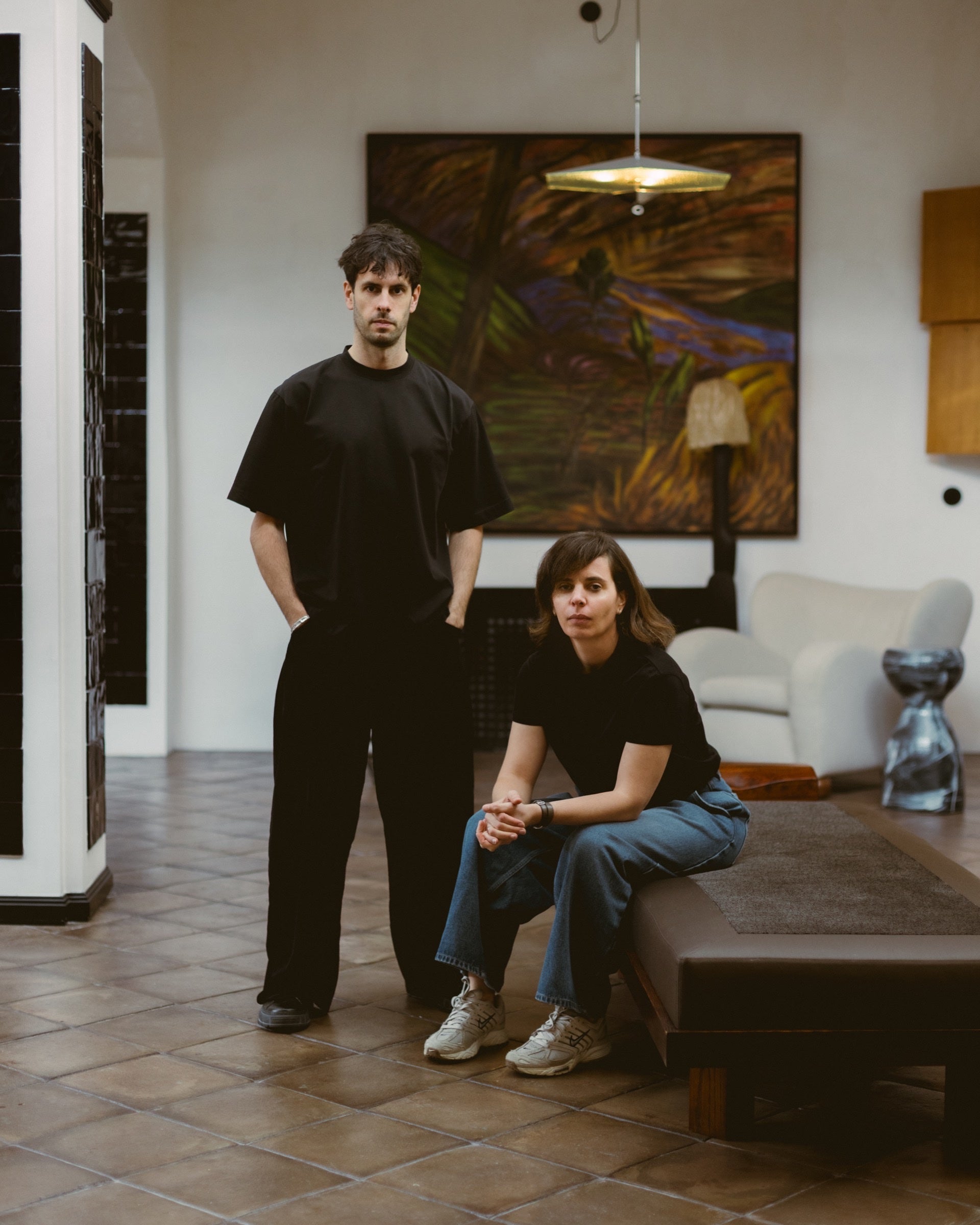
Olivier Garcé and Clio Dimofski
Artist Conversations
Garcé Dimofski: Atmosphere, Craft, and Complete Worlds
Founded by Olivier Garcé and Clio Dimofski, Garcé Dimofski is a multidisciplinary studio based in Porto and Lisbon. From architecture and interiors to bespoke furniture and collectible objects, their work is shaped by material honesty, craftsmanship, and atmosphere. In this interview, they share the inspirations, processes, and collaborations behind their universe.
What first drew you to the world of art and design? Was there a defining moment or experience that set you on this path?
Can you tell us about your creative process? How do ideas come to life for you, from the first spark to the finished piece?
Our creative process often begins with an atmosphere rather than a precise form. It can come from a place like Casa de Chá by Siza—with its relationship to landscape, proportion, and silence—from furniture by René Prou, from a memory, a material, or even a gesture observed in a workshop. We usually start by building a visual and emotional world around a project before moving into drawings, proportions, and material tests. From there, the process becomes deeply collaborative. We work closely with artisans and workshops, and we like the making process to influence the final result. A piece often evolves through prototypes, technical constraints, small imperfections, and conversations with craftspeople. We like when the final object keeps something of that journey—when it feels designed but not overly controlled.

Materials often tell their own stories. How do you choose your materials, and what kind of dialogue do they create within your work?
Materials are central to our work. We are drawn to materials that have depth, texture, and honesty—wood, ceramic, plaster, stone, iron, and textiles. We like when a material is not completely neutral, when it brings its own character, irregularities, and history into the piece. We often choose materials for the atmosphere they create as much as for their function. A ceramic surface, patinated wood, plaster finished by hand, or a textured fabric can introduce warmth and intimacy. The dialogue we look for is between refinement and imperfection—between something carefully composed and something that still feels human, tactile, and alive.
How has your style or approach evolved over the years? Were there pivotal moments that shaped your evolution as an artist/designer?
Our approach has become more precise and more personal over time. In the beginning, our work was mainly rooted in interiors and architecture. Gradually, we became more interested in creating complete environments, where furniture, artworks, materials, colors, and architecture all speak the same language. Moving to Portugal was an important moment for us. Being closer to crafts, workshops, and slower forms of production changed the way we work. It encouraged us to develop pieces with more attention to materiality, handwork, and local knowledge. Opening our showroom in Porto also marked a new chapter—it allowed us to present our world in a more complete way, as a living dialogue between architecture, art, design, and craftsmanship.


Your work often balances personal expression and external expectations. How do you navigate that?
We try to listen carefully without losing the essence of our work. Whether it is a private interior, a furniture piece, or a collaboration, there are always expectations, constraints, and practical needs. We believe the strongest projects happen when those constraints are absorbed into a clear creative vision rather than treated as limitations. Our work is personal, but it is not closed. We like dialogue with clients, artists, designers, artisans, and galleries. The important thing is to remain faithful to a certain atmosphere and sensitivity, while allowing each project to find its own balance.
“We like when the final object keeps something of that journey—when it feels designed but not overly controlled.”
— Garcé Dimofski
What role does art and design play in today’s rapidly changing world? Do you feel it has a responsibility or specific function in addressing contemporary issues?
We believe art and design have an important role today because they can slow things down. In a world that moves very quickly and often feels increasingly digital and disposable, objects and spaces can reconnect us to time, craft, material, and emotion. For us, responsibility is not only about making statements. It is also about how things are made, who makes them, how long they last, and what kind of relationship they create with people. Design can encourage a more thoughtful way of living—one that values quality, care, and permanence over constant novelty.
Is there a particular piece, collection, or project that holds a special place in your heart? What makes it so significant to you?
Our Porto showroom holds a very special place for us. It is not just a showroom, but a physical expression of our universe. It brings together our furniture, the work of artists we admire, architectural details, craft, and objects in a way that feels very close to who we are. It is significant because it represents a shift from designing individual projects to creating a broader world around Garcé Dimofski. It has become a place where collaborations, exhibitions, conversations, and new ideas can naturally emerge.

Where do you turn for inspiration? Are there rituals, places, or people that continually spark your creativity?
We find inspiration in places, artworks, and moments that carry a strong atmosphere. A place like Casa de Chá by Siza, furniture by René Prou, a work by Tracey Emin, an old interior, a landscape, a studio visit, or a material discovered in a workshop can all become starting points. We are drawn to things that are precise but emotional, composed but never cold. Portugal is also a strong source of inspiration for us—through its light, its materials, its craft traditions, and its quiet sense of melancholy. We are constantly inspired by the artisans and artists we work with. Their knowledge, gestures, and ways of thinking often open new directions in our work.
What excites you most about the future? Are there new ideas, collaborations, or mediums you’re eager to explore?
We are excited by the possibility of deepening the dialogue between design, art, and craft. Collaborations are becoming increasingly important to us, especially when they allow different creative languages to meet within our own aesthetic universe. We are also interested in developing more collectible pieces, more limited editions, and more projects that connect our architectural approach with the intimacy of handmade objects. The future, for us, is about continuing to build a world that feels coherent, emotional, and deeply connected to craftsmanship.
Never Miss a Masterpiece
Stay connected with Garcé Dimofski and be the first to discover their latest creations.
Follow now to unlock exclusive updates and elevate your collection.